
(The CV of Then)


For nearly 40 years, including my pre-public service career, it was a part of the uniform, a tie with a single Windsor knot. Usually blended with an Oxford pinpoint, the combination served as a subtle offset to one of the Hickey Freeman’s hanging in the closet. Mixing and matching was a daily ritual, including sliding into a black or brown pair of Allen Edmond’s finest. Fully spiffed and ready to go, it was off to oblige the day’s sampling of some 60 California client agencies. After all, an expert must look the part.
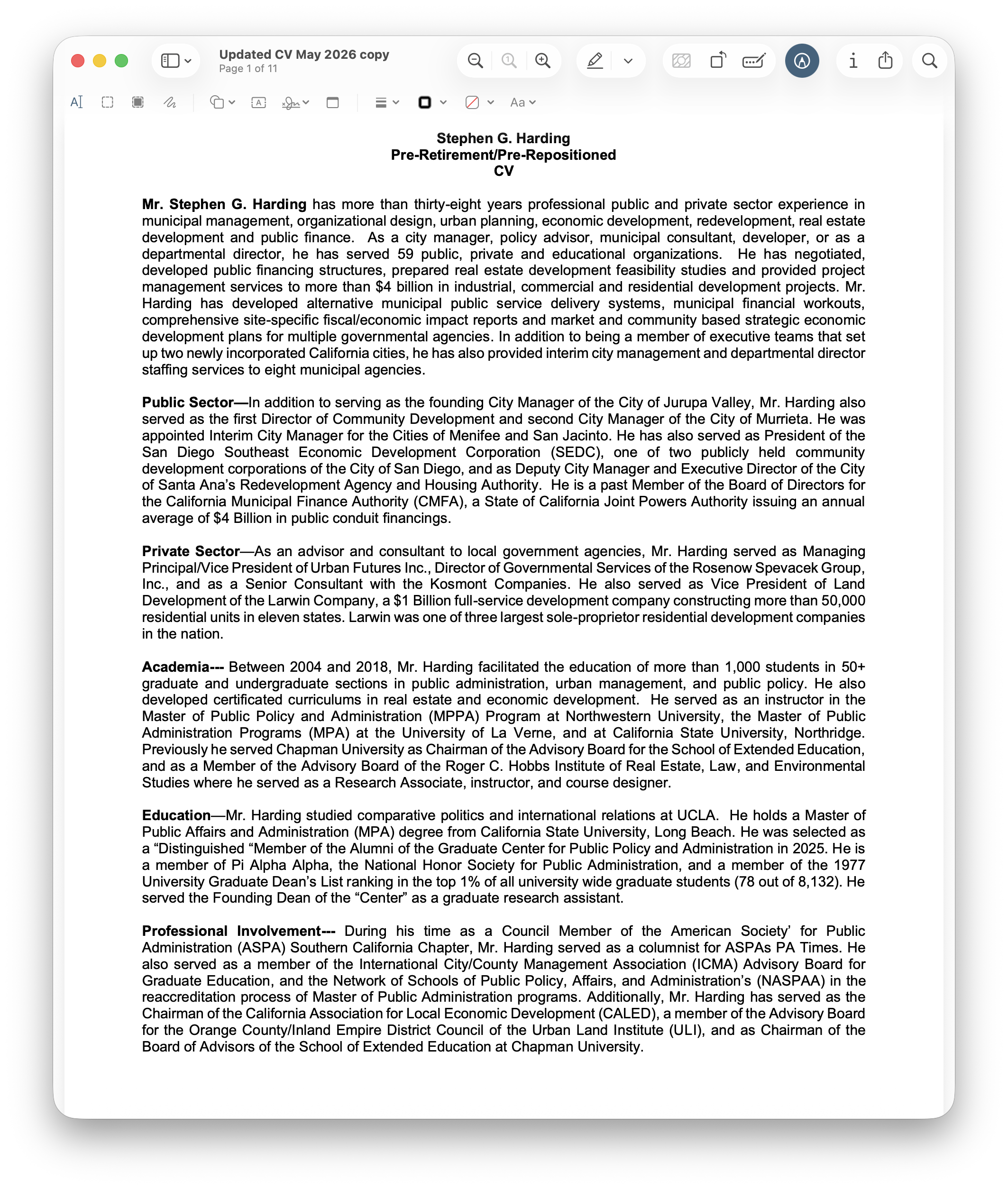
The majority of purchasers of my professional services were local governments. Universities, real estate developers, retailers, and non-profits made up the balance. Having worked in public, private, and university settings, I had accumulated the full array of skill sets and responsibilities appurtenant to multiple career ladders: city manager, director (executive and otherwise), managing principal, vice president, senior consultant, advisor; I had even been president of a municipal 504 (c) (4) economic development corporation for “America’s Finest City.” The populations of my local government agencies ranged in size from a few thousand too over a million. Whether in inner-city, suburban, or agriculturally based rural environments, I didn’t miss much of California’s political, socio-economic, ethnic, and cultural topography.

Assignments were as variable as the clientele. From cities of all shapes and sizes to boutique consulting firms, to two of the biggies: One of the nation’s largest sole proprietor residential development companies and the largest big box membership retailer. Clients such as these made it quite clear that technical and financial savvy were just as critical as managerial and leadership skills. Balancing long-term strategic planning with short-term tactical political maneuvers require an inherent understanding of each. Strategies required vision, patience, perseverance, and a long-term buy-in of the players. The demands of short-term political necessities and the dictates of the time value of money required a more transactional approach.


Wearing my private sector hat, uh, tie, I negotiated, developed public financing structures, prepared real estate development feasibility studies, conducted pro forma analyses, and provided project management services to more than $4 billion (present value at the time) in industrial, commercial, and residential development projects. That was on top of approving an additional $3 billion in conduit financings as a board member of the California Municipal Finance Authority (CMFA). Still, there were other assignments including organizational assessments, executive recruitment, interim management staffing services, municipal financial workouts, site-specific fiscal/economic impact reports, and market-based strategic economic development plans. For me, the rewards came with the variety of assignments, not through the familiarity of a single workplace. It was about breadth as well as depth.


Two of my greatest opportunities came while I served as an executive team member in the establishment of two newly incorporated California cities: As the first community development director and later, as the second city manager in one, and the founding city manager in the other. Very few in the profession get the chance to pour a municipal foundation. I got the opportunity twice. It was creating not amending.
These were major learning moments. From infancy to adolescence, and through the various levels of adulthood, cities, like people, go through their own maturation processes. Most public servants start careers in agencies that are well-aged, not necessarily well-heeled. Fledgling municipalities are more primal, at least the ones without a significant tax base to begin with. They occupy the lower rungs of Maslow’s Hierarchy of Needs, searching for shelter, food, mates, and their own identity. Lines are still being drawn. Competing visions and interests are still being defined. Expectations are high, revenues lag, while the city council chambers has standing room only. The pressure is on to get everything right, right now. Over time, memories of those initial expectations and efforts fade. Current affairs, replacement personalities and an evolving groupthink, take precedence. The first in were the first out, a part of yesterday’s news. One thought that the decisions of the city’s founders would remain cast in concrete. Tell that to the self-absorbed successors in interest.
Still, there were other ways to contribute and find professional satisfaction. I had an avocation. Overlapping my day job, I was an adjunct instructor in graduate programs in public policy and administration. Since classes normally clocked in at 6:00 p.m., I entered the classroom more wrinkled than spiffed. Between 2004 and 2018, I facilitated the education of more than 1,000 graduate students in 50+ sections in the theory and practice of public administration, public policy, urban management, economic development, metropolitan globalization policies, and sustainability. Mentoring, serving on advisory boards, writing for academic journals, and developing classes and curriculums came with the territory. Whether sitting at the dais, pontificating at the podium, or lecturing from where else, the lectern, I was a card-carrying member of the knife-and-fork speaking circuit. Hardware, plaques, and gavels, were collected along the way. Sleep deprived, I guess some people just like to hear themselves talk.


Leave it better than you found it. Leave it on your own terms. Leave it with your integrity intact.
My suit and tie days are over. The time of being one of San Diego’s 88 in 88, or one of CALED’s 40 over 40 years is past. That’s all in the rear view mirror. This is now. There are other ways to contribute that are not directly related to my past professional self. Teaching is now “THE” vocation, with some volunteer board responsibilities on the side. It’s now about being appreciative of where I am, staying engaged, and paying it forward. Call it another graduation where the judgments, approval, or even the accolades of others are neither solicited nor required. What I do expect: a returned email or text message. I gave up on phone calls years ago. In any event, I’m hoping to continue to make a difference, trying to make the lives of those around me just a little fuller. Since the seat belt sign is off, I am free to move about the cabin. Besides, my current wardrobe requirements have been somewhat reduced. Depending on the day and time, even shirts with collars are optional. And the shoes? My God–Real comfort at last.


Pre-Retirement CV
Discover more from Our Civic Culture
Subscribe to get the latest posts sent to your email.
fantastic career! can you remember our day’s in azusa ? very proud to be amongst your admirers! cheers Roger